15 April 2026 What do the election results mean for our local Councils?
For the County Council,
LRA no longer has representation. Also the Conservatives have lost
their majority to Reform who now control the Council and have a
majority as large as the previous conservative one. More.
For the District Council,
there were 18 seats up for election this year out of a total of 54. LRA
stood for the four Loughton seats and held three. LRA now has 12 seats,
the Conservatives 19 seats, Reform 12 seats, the Liberal Democrats 6
six seats and others have five seats. No one party has a majority.
Going forward separate parties will need to work together to get
anything done, and the LRA District Cllr group has already considered
this point and discussions have started.
However
this situation is likely to be short-lived as the plan for Local
Government Reorganisation means that the County Council and District
Council will cease to be after 1 April 2028, and replaced by five new
councils covering separate areas of Essex. For our area Epping Forest
District Council will be absorbed into a new West Essex council which
will also include the current local government areas of Harlow and
Uttlesford. Elections to these new councils will take place in May 2027.
For the Town Council, there were no elections this year, so LRA retains it's 21 (out of 22) Town Cllrs with the next elections in 2028.
24 April 2026
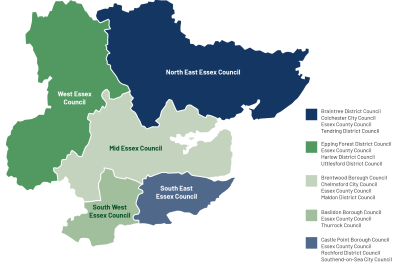
More details have been released on what happens next as plans are made for introducing the five new councils covering Essex.
Epping
Forest District Council will be absorbed into a new West Essex council
which will also include the current local government areas of Harlow
and Uttlesford.
Elections
for the new councils will take place in May 2027. After the elections,
a shadow council will be set up. A shadow council is a temporary body
made up of the newly elected councillors. Its role is to: • prepare for the official launch of the new councils • agree budgets, policies, and governance arrangements • ensure everything is ready for the transfer of services from 1 April 2028.
Until
1 April 2028, all day-to-day services will continue to be run by Essex
County Council and the 15 unitary, district, city and borough councils
in Greater Essex. After that date, the new councils will begin to
align services, systems and ways of working. This won’t happen all at
once. Instead, they will introduce changes gradually over time to make
sure they are well planned, practical and easy for residents to adapt
to. More
The Government has already announced that the Greater Essex Mayoral election will take place in May 2028.
27 March 2026 The Government has announced
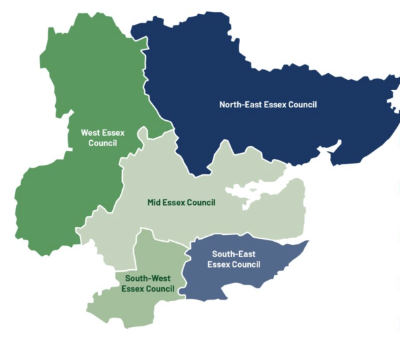
that Essex will have five unitary authorities from 2028. Epping Forest
will be abolished and will be merged with Harlow and Uttlesford under a
West Essex Council. As well as all the main services currently provided
by the district councils, the new unitary authority will also deliver
services currently provided by the County Council.
The authorities covering Essex will be: • West Essex Council (current local government areas of Epping Forest, Harlow and Uttlesford) • North East Essex Council (current local government areas of Braintree, Colchester and Tendring) • Mid Essex Council (current local government areas of Brentwood, Chelmsford and Maldon) • South West Essex Council (current local government areas of Basildon and Thurrock) • South East Essex Council (current local government areas of Castle Point, Rochford and Southend-on-Sea).
Epping
Forest District Council and Essex County Council had supported three
larger authorities, and have published their responses to the decision here and here.
LRA Comment:
Each of the five authorities will cover a larger population than the
current district councils, so there is a risk of a democratic deficit
with new authorities not being responsive to local needs, especially
around approving local developments and planning applications. This
risk would have been greater with only three authorities covering even
larger populations.
Going
for five unitary authorities may preserve local identity but it would
also be financially less sensible in that Officer posts would need to
be duplicated. Also the new authority might be at a financial
disadvantage in relation to procuring children and social services,
which are very expensive.
16 January 2026 Local elections Following the Government’s recent decision
to defer the Mayor of Greater Essex election from 2026 to 2028, the Government
offered to affected local councils a postponement of May's local elections.
District Council group leaders subsequently met to discuss the offer. Despite
hearing about the cost of holding elections and that they risked delaying local
government reorganisation, group leaders agreed that elections should still
take place and no extraordinary meeting of full Council will be required to
formalise the council’s response. More
The final decision by the government on deferral of the elections is expected in the next few weeks.
18 District Council seats held by Cllrs who came third in the all-out,
three-member ward elections in May 2024 will be up for election. These
include four LRA Cllrs in the District Council's Loughton wards.
19 December 2025 The
Government has announced that the Greater Essex Mayoral election,
originally planned for May 2026, will now take place in May 2028.
The
delay is intended to allow more time for councils to establish new
Mayoral Strategic Authorities and work together before the first
mayoral elections. This announcement does not impact local elections,
and further clarification is expected in due course.
28 November 2025 The
government is now seeking views from residents on the different
proposals submitted by councils for the reorganisation of local
government in Essex, Southend-on-Sea and Thurrock. The proposals are here.
A preferred option is likely to be announced by Government in the spring of 2026.
31 October 2025 A Mayor for Essex
If
reorganisation of local government in Essex proceeds, in May next year
there will be elections for a Mayor heading a new Mayoral Combined
County Authority (MCCA). The MCCA would be responsible for such areas
as transport and local infrastructure, skills and employment support,
housing and strategic planning, economic development and regeneration,
environment and climate change, health, wellbeing and public service
reform and public safety.
The MCCA would also become the fire
authority for Greater Essex and the Mayor of Greater Essex would become
the police and crime commissioner for Essex Police from April 2027. Read more here in this County Council report.
Although
there are in theory elections to the District and County Councils next
year we expect that owing to the government reorganisation plans, these
will be postponed.
10 October 2025 Four
different proposals have now gone forward to the Government for
consideration. Provided they meet the criteria set out earlier in the
year, these proposals will go forward for public consultation later
this autumn, with a preferred option likely to be announced by
Government in the spring of 2026. More
• Southend-on-Sea City Council, along with nine
district, borough and city councils, has put forward a plan for five
unitary councils. • Thurrock Council’s proposals focus on dividing Greater Essex into four new unitary councils. • Rochford Council has put forward a different proposal for a four unitary councils model. •
Essex County Council, along with two district councils, is proposing a
configuration of three new unitary councils.
19 September 2025 The
County Council's preferred option proposed is for three Authorities,
with the existing Epping Forest District Council combined with
Brentwood, Chelmsford, Harlow, and Maldon Councils. This would result
in Loughton being at the far western edge of the new area, and with the
Authority based in Chelmsford.
The County Council's proposal
was taken to Cabinet and Full Council meetings on 18 September and
approved. This will now be submitted to Government on 26 September. More
Alongside
the County Council's proposal, Southend-on-Sea City Council is leading
a proposal for five councils. Thurrock Council is developing a proposal
based on four and Rochford Council may also submit a different proposal
for four councils. More
The
government will consider all proposals before deciding which proposals
will go forward to public consultation. This is anticipated in the
autumn.
The
Government has indicated Neighbourhood Area Committees are its
preferred approach to addressing the issue of localism (as opposed to
creating new parish or town councils) with the committees populated by
all elected members from within that locality and representatives from
Police, Fire and Health (amongst others) as additional non-voting
members. This is because many areas don’t have Town or Parish councils
(and some of the ones that exist are ineffective).
29 August 2025 As
planning for reorganising local government in Greater Essex goes
forward, a new website has been launched to help residents, businesses
and stakeholders stay informed and involved.
The new website offers:
An overview of Local Government Reorganisation (LGR) in Greater Essex
A short explanatory video
The government’s aims for LGR
Latest news and updates
Frequently asked questions
Councils
are currently developing business cases that explore options for
unitary arrangements as part of local government reorganisation (LGR).
These will be made available in both full and summary formats as they
are finalised.
If
proposals are agreed there will be a public consultation. Elections to
new shadow unitary councils could be expected in May 2027; new unitary
councils could be fully live in April 2028. More
LRA
Cllr Chris Pond reports that he understands there will be another
iteration to the plan, which is to remove Wickford and Runwell from the
South Essex Unitary and add it to the Central Essex Unitary (which
would also cover Epping Forest).
4 August 2025 The County Council have confirmed a preference for three unitary councils in Greater Essex.
Central Essex Unitary: Epping Forest, Chelmsford, Brentwood, Harlow, Maldon
South Essex Unitary: Southend, Rochford, Castle Point, Basildon, Thurrock
North Essex Unitary: Colchester, Tendring, Braintree, Uttlesford
The
recommendation will now be included in a formal business case to go the
government by 26 September, after which they will consider all
proposals before deciding which business cases will go forward to
public consultation.
4 July 2025 15
councils across Essex, along with the Office of the Police, Fire and
Crime Commissioner, are beginning to gather residents’ views and
priorities to help shape local government reorganisation across Greater
Essex.
A
telephone and written survey of 1,400 residents is currently being
undertaken with feedback informing business cases being developed by
the councils, which are due to be submitted to the Government in
September. The survey will be conducted online and by telephone.
Alongside
the survey a workshop involving residents will explore views in greater
depth and focus groups will be held involving an additional residents
from under-represented groups, including young people, ethnic minority
communities, and disabled residents, to ensure perspectives are
included. More
17 April 2025 An
initial plan setting out how Greater Essex councils could best respond
to the challenge from government and achieve more for residents and
businesses, has been shared with the Government. The 15 Essex councils
and the office of the Police, Fire and Crime Commissioner, developed
the joint, interim plan for local government reorganisation in Greater
Essex. Read the plan here (PDF) Although
the plan does not include final recommendations for the future
structure of local government in the area, some councils have expressed
an in-principle preference to work toward five new unitary authorities
for Greater Essex.
Work will now continue up to September to
inform a final business case. This will be submitted to the Government
in line with its 26 September deadline.
The Government will decide what the final structure will be for Greater Essex councils.
7 March 2025 With
Essex now in the government’s Priority Programme for devolution
(background on our website), the Government has launched a public
consultation on the changes.
It includes questions on the
proposed geography and how the Combined County Authority will make
decisions, together with questions on the effects of working across
this geography through a Mayoral Combined County Authority, and
specifically asks about:
The proposed geography
Governance arrangements
Supporting the economy
Improving social outcomes
Improving local government services
Improving the local natural environment
Supporting the interests and needs of local communities and reflect local identities
The
District Council has said that this consultation is not about the Local
Government reorganisation of the district and other district and
borough councils into unitary authorities. That process will take place
separately and subsequently.
14 February 2025
As
expected, the Government has agreed to the County Council's request to
include Essex in the government’s Priority Programme for devolution. The Order postponing the election has now
been laid before Parliament (SI 2025/137).
The
immediate impact is that County elections planned for May 2025 and
possibly 2026 will be set aside. Existing Cllrs will remain in place in
their existing county divisions and district wards until new elections
are held (with the boundary changes that created two County Council
divisions to cover Loughton from May 2025 being put on hold).
The
councils will now begin working with each other and the Government as
part of the programme. There will be an enormous amount of planning and
work required over the next 2-3 years to get the new structures and
organisations in place.
The key
change is the creation of unitary authorities to cover perhaps about
500,000 people each, replacing existing district and county councils.
This would mean that Epping Forest District Council and Essex County
Council would cease to exist. Essex would then be served by
between two and five 'unitary authorities' that cover a yet to be
determined area of Essex.
There
would also be a Combined County Authority covering all of Essex with an
elected Mayor. The Mayor would also take on the responsibilities of the
existing Police, Fire and Crime Commissioner.
The County Council discussed this at a council meeting on 10 January (the full briefing is here), and has now written to the government to request inclusion on the government’s Priority Programme. More
If
the government agrees (which appears likely), details of how the new
structure would operate and how the transition from old to new would be
worked out. The immediate impact would be that County elections
planned for May 2025 and possibly 2026 would be set aside. Existing
Cllrs would remain in place in their existing county divisions and
district wards until new elections are held (with the boundary changes
that created two county council divisions to cover Loughton from May
2025 being put on hold). Postponement has generally been a
feature when local government reorganisation is taking place, as it
was, for example with abolition of the Greater London Council
(1985) and the abolition of Buckinghamshire County Council (2021)
For
Loughton, the existing Town Council would continue. The proposal only
briefly mentions parish and town councils with 'we will also rewire the
relationship between town and parish councils and principal Local
Authorities, strengthening expectations on engagement and community
voice' however what this means in practice remains to be seen.
The
existing Epping Forest District Council would be folded into a much
larger unitary authority, presumably combined with nearby areas. The
District Council currently serves around 135,000 people, so the new
authority would be much larger though the number of Cllrs would
undoubtedly be reduced.
Much
detail remains unknown, including any changes to how the new bodies
will be funded; a reorganisation could result in saving money, however
this would be insignificant compared to the well-known scale of
underfunding for local government.
LRA
thinks there is also a risk of a democratic deficit with larger unitary
authorities not being responsive to local needs, especially around
approving local developments and planning applications.



 24 April 2026
 27 March 2026